

Failure to Stop vs. Rolling Stop: Liability in Nevada Stop Sign Crashes
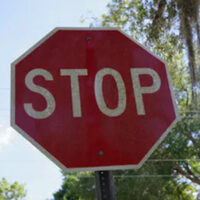
You know what a full stop looks like. The car rocks back. The wheels stop turning. There’s that brief, boring pause before you go. That is not what happens at most Nevada stop signs. What you actually see, especially around Las Vegas, is the “Nevada roll.” That’s a slow crawl through the intersection, a tap on the brakes, and then a lunge into traffic. Drivers tell themselves: “I slowed down. I checked. It’s fine.” Until it’s not fine. Until two cars meet in the middle of the intersection and somebody ends up in an ambulance.
At Mainor Ellis Injury Lawyers, we see a lot of intersection crash reports that look the same: one driver swears they stopped, and the other swears they had the right of way. Under Nevada law, that “little roll” at a stop sign can be the difference between no fault and clear liability.
What Nevada Law Actually Requires at a Stop Sign
Under NRS 484B.257, when you approach a stop sign in Nevada, you must come to a full and complete stop at the:
- Clearly marked stop line; or
- Before entering the crosswalk; or
- At the point nearest the intersecting roadway where you can see approaching traffic.
The law always requires you yield the right of way to any vehicle in the intersection and any vehicle approaching so closely as to constitute an immediate hazard.
“Full and complete stop” means motionless. That’s wheels stopped, vehicle stationary. Rolling at 3 mph does not count.
If you blow through the sign without even slowing, that’s an obvious violation. If you slow down but never fully stop, that’s a rolling stop, that’s still a violation, just harder to prove without good evidence.
Either way, failing to follow NRS 484B.257 can be a powerful piece of the liability puzzle in an injury case.
Failure to Stop vs. Rolling Stop: Why the Difference Matters
From a crash victim’s perspective, both failures look the same because you followed the rules, the other driver didn’t, and you got hit. Makes sense, right?
But from a legal and insurance standpoint, there are nuances. That’s because a clear failure to stop often results in a traffic citation and is easier to prove with witness statements, video footage, and skid marks (or lack of them).
With a rolling stop, on the other hand, the driver will often say: “I stopped,” or “I slowed way down.” Police may or may not issue a ticket. And liability fights tend to focus on the speed of both vehicles, sight lines and obstructions, as well as timing (who entered the intersection first).
In both cases, Nevada law doesn’t care how you label what you did. It cares whether your actions matched what NRS 484B.257 requires, and whether that failure caused the crash.
At Mainor Ellis Injury Lawyers, we end up spending a lot of time on details like “six feet back from the line” and “three seconds vs. one second” because those details drive fault arguments.
Before you give a recorded statement, sign anything, or accept a quick settlement, get advice from someone whose loyalty is 100% to you, not to a claims department. That’s a Las Vegas car accident lawyer who has your back 24/7.
Get Our Legal Help Today
If you were hurt in a stop sign crash anywhere in Nevada—Las Vegas, Henderson, Reno, or on a rural two‑lane road—contact Mainor Ellis Injury Lawyers for a free, confidential consultation. We can help you figure out your next steps to ensure you’re getting the compensation to which you’re entitled to. Call at 702-450-5000 today.
Source:
leg.state.nv.us/nrs/nrs-484b.html
